FP

Flag football

Flag Football Playbook

A flag football playbook is only worth what your team can run on Saturday. This is the tool coaches use to draw the concepts, animate them so the timing is honest, get them onto a wristband and pull them up on the sideline — from 5v5 through 9v9.

  • 5v5, 6v6, 7v7, 8v8 and 9v9 fields and alignments
  • Routes, motion, runs, handoffs, laterals, screens
  • Animation that respects real exchange timing
  • Wristbands, shared team books and a sideline view

Free to start · No account required

Patriot Pass
Published by a coach
CQBXYZ
A real 5v5 play published to Discover, drawn in this editor — motion before the snap, a moving quarterback and receivers working at three different depths.

Written and reviewed by Matt Sullivan, flag football coach and founder of Football Playbook · Updated September 2026

Flag football is not a niche anymore

More first-time coaches are being handed a roster and a Saturday than at any point in the sport's history. Most of them inherit no playbook at all.

102,360

girls played high school flag football in 2025-26 — up from 15,716 in the 2021-22 survey.

NFHS High School Athletics Participation Survey

3,990

high schools reported girls flag football programs last year, with 37 states sanctioning or piloting the sport.

NFHS High School Athletics Participation Survey

LA28

Flag football was added to the Olympic programme for Los Angeles 2028 by the 141st IOC Session in October 2023.

International Olympic Committee

Figures published by the organizations named above. Football Playbook does not publish participation estimates of its own.

Four concepts worth studying, drawn by coaches

These are real plays published to Discover — not mockups. Each one is here because it teaches something you can steal, adapt to your personnel and install this week.

Stretch the flat defender

Flood R Zip

5v5 Flag
CQBXYZ

A flood sends multiple receivers to the same side at different depths so one defender has to cover two answers, and the quarterback rolls that way to shorten the throw. The detail worth copying is the backside: one of your fastest players leaves the crowd entirely. If the defense over-rotates to the flood, that's the play.

Open Flood R Zip and press play

Motion plus a moving pocket

Patriot Pass

5v5 Flag
CQBXYZ

Motion resets the strength before the snap, then the quarterback rolls to that side. Because the roll shortens the field to one half, the read stacks vertically — deep, intermediate, short — with the center releasing late as the check-down. That last part is what makes it teachable: there's always somewhere to go with the ball.

Open Patriot Pass and press play

One rule, both sides

Twins left - WHIP

5v5 Flag
CQB231

Whip routes mirrored either side of the ball: break in, then snap back out. What makes it worth copying is the symmetry — players learn one rule instead of two assignments, and the quarterback simply throws away from the defender's leverage. Note the receivers are numbered rather than lettered, which is how a lot of coaches tie a diagram to a wristband.

Open Twins left - WHIP and press play

Bunch the picture

Quad

7v7 Flag
CQBXYZHRBA

A 7v7 look with receivers stacked tight to one side. Compressed alignments make the defense declare man or zone before the snap, and the traffic near the line does the separating — which matters when you're coaching players who won't consistently win one-on-one. The routes then spread to different depths off that bunch.

Open Quad and press play

What actually changes when you move up a format

It isn't just extra players. Every added body changes spacing, which changes what your concepts are allowed to ask for.

How flag football formats differ
FormatWhat changes
5v5Center, QB, three receiversNowhere to hide. Every player is a read, the center is a live receiver on release, and one missed assignment is the whole play.
6v6Adds a sixth eligibleYou get a genuine third level or a lead blocker. Crossing concepts start working because there's a body to occupy the middle.
7v7Full route tree, room for a backCoverage looks matter. Offenses can flood one side and still hold the backside honest.
8v8Adds a real run gameSweeps, options and pitches become live calls, so ball-handling rules and exchange timing matter as much as routes.
9v9Widest flag alignmentClosest to a full-field picture: alignment discipline and sideline-to-sideline spacing drive everything.

Installing

Drawing a play isn't installing a play

A play is installed when the team can break the huddle, line up correctly, execute their own assignment and do it at close to game speed without a coach walking anyone to their spot. Everything before that is a diagram.

That's why the editor animates. Press play and you find out whether motion actually arrives before the snap, whether the exchange is physically possible, and whether the crosser is anywhere near where the ball is going. Most over-designed plays fall apart on screen before they ever waste a practice rep.

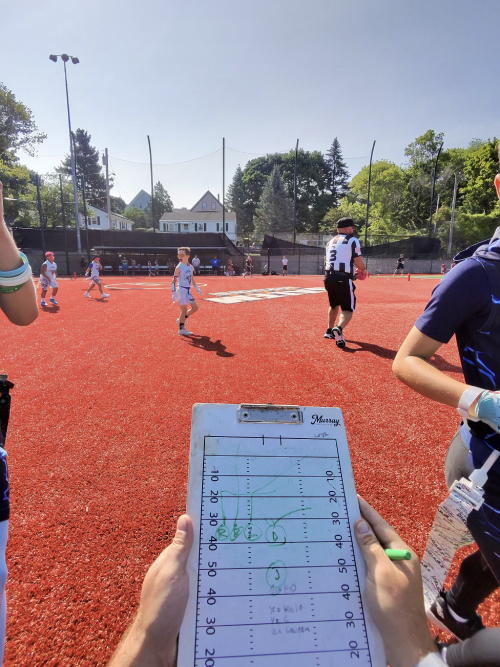
Coach's clipboard with hand-drawn flag football plays
Most flag playbooks start here. The problem isn't the drawing — it's that this version only exists on one clipboard.

Flag isn't only routes

Run game, ball actions and defense all live in the same editor. These three are published plays from three different formats.

Ball actions

Option pitch

8v8 Flag
CQBXYZHARB

An 8v8 option with a pitch. Two ball actions in one play means the timing has to be real, so the animation enforces it — the pitch can't travel forward and the exchange only happens if the players are actually near each other.

Open Option pitch and press play

Defense

DS 1

7v7 Flag
CQBXYZHRBD1D2D3D4D5D6D7

A published 7v7 defensive shell: corners with inside leverage, spies responsible for the flats. Drawing your defense the same way you draw offense is the fastest way to show a player what 'you have the flat' actually means.

Open DS 1 and press play

Wristbands

Organized so a kid can find the call

The point of a wristband isn't how many plays fit on it. It's whether a player hears a number and lands on the right box without hunting through a wall of tiny diagrams.

Number your plays the way you call them, keep situational calls together, and print the layout that stays readable for your age group. The preview on screen is drawn by the same renderer that generates the PDF, so nothing shrinks unexpectedly on paper.

Football PlaybookGame Day
Trips Right — Smash
Mesh Concept
Goal Line Slant
Flood Right
Trips Right — Smash
Mesh Concept

Game day

The playbook shouldn't disappear when practice ends

Game Mode is the game-day version of your playbook, not the editor squeezed onto an iPad. One large diagram, oversized next and previous controls, the calls you starred before kickoff and a compact scoreboard.

Pull it up, move through calls quickly, show a player exactly what you're running when you need to, and get back to coaching. It's read-only, so nothing gets edited by accident on a sideline.

My Library — Desktop
Library
CQBXYZ

Trips Right — Smash

CQBXYZH

Mesh Concept

CQBXYZ

Goal Line Slant

Editor — Tablet
CQBXYZ
CQBXYZ
PlaySave

Your staff

One current version, not six screenshots

The biggest coordination problem in youth and adult flag isn't play design — it's version control. Screenshots, group texts, whiteboards and separate notes are how two coaches end up teaching two different versions of the same play, and the players are the ones who pay for it.

A shared team playbook gives the whole staff one source of truth. When you adjust a route on Wednesday, your assistants are coaching the adjusted version on Saturday.

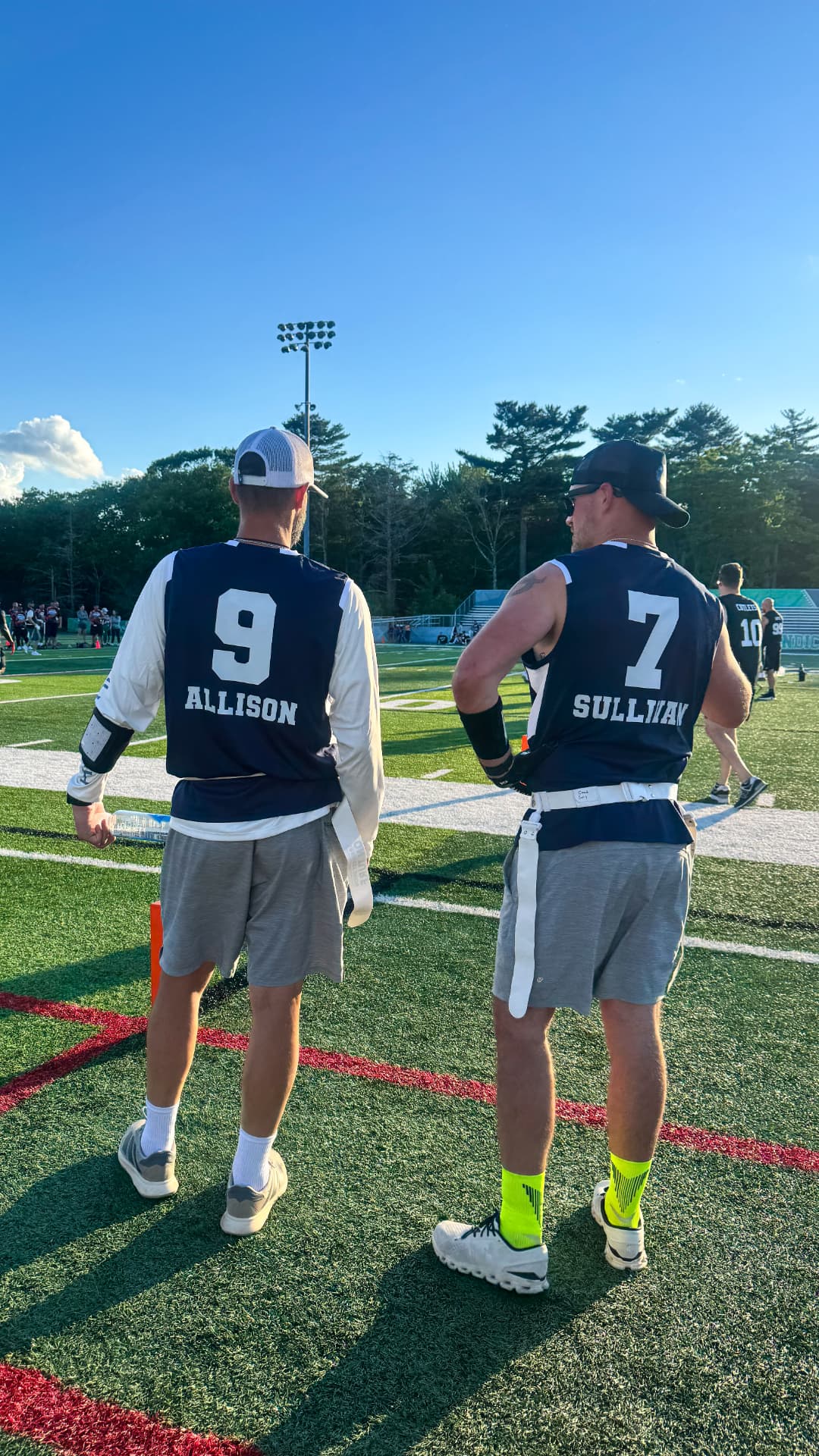
Flag football coaches talking through calls on the sideline during a game
Two coaches, one call sheet. That only works if the playbook they're both looking at is the same one.

Frequently asked questions

What actually belongs in a flag football playbook?
Answers to the situations you'll face, not a catalogue. You need something that works on first down, something that beats a rush, one or two ways to attack down the field, a short-yardage call and a goal line call. Everything after that is variation — the same concept from a different alignment or with motion attached. A book of eight plays your team can run beats a book of twenty-five it can't.
How many plays should a flag football team carry?
Fewer than most coaches think, especially with young players. The test isn't how many are drawn, it's how many the team can break the huddle with, line up correctly for and run at close to game speed without a coach directing traffic. Add a play when the ones you have are genuinely installed, not because the wristband still has empty slots.
What does it mean for a play to be 'installed'?
Not that you drew it on a board and explained it once. It's installed when every player lines up right, knows their own assignment and executes it at something close to game speed without constant coaching. Repetition gets you there faster than adding another play does.
What's the most common mistake in flag playbook design?
Over-designing. It's easy to draw something that looks incredible on a screen and requires five players to execute perfectly timed movements just to create one opening. The play has to survive real kids running it. Good spacing, simple assignments and putting one or two defenders in conflict beats spaghetti every time.
Which flag formats does Football Playbook support?
5v5, 6v6, 7v7, 8v8 and 9v9. Each opens with the right player count and a sensible starting alignment, and every player is draggable and re-labelable. A play drawn in one format can be switched to another and the alignment migrates with it, so moving up a level doesn't mean redrawing the book.
Can I draw motion, runs, handoffs, laterals and screens — not just routes?
Yes, and they behave like the real thing. Motion runs before the snap during playback so you can see whether the player actually arrives in time. A handoff requires the two players to be physically close at the exchange, and a lateral can't travel forward. Screens and blocks end in a bar instead of an arrowhead, so a diagram never implies contact your league doesn't allow.
How should I organize plays on a wristband?
Around how fast a player can find a call, not around hitting a play count. Group by situation the way you actually call them — base concepts together, goal line together — and number them so a kid hears a number and lands on the right box. Football Playbook prints several wristband layouts; pick the one that keeps your call sheet readable rather than the one that fits the most plays.
Can my assistant coaches work from the same playbook?
Yes, and it's the main reason to keep the book in one place. Screenshots, group texts, whiteboards and separate notes are how two coaches end up teaching two versions of the same play. A shared team playbook gives the staff one current source of truth, and a change you make is the change everyone sees.
Do I need an account to draw a play?
No. You can open the designer, pick a format and draw a full play without signing up. An account is what lets you save it, organize it into playbooks, share it with your staff, print wristbands and open it on the sideline.
Build a flag football playbook your team can actually run

Pick your format, draw the concepts you already coach, and see whether the timing holds up before you spend a practice on it.